

Detailed Joint Evaluation to Determine If Surgery Can Be Avoided
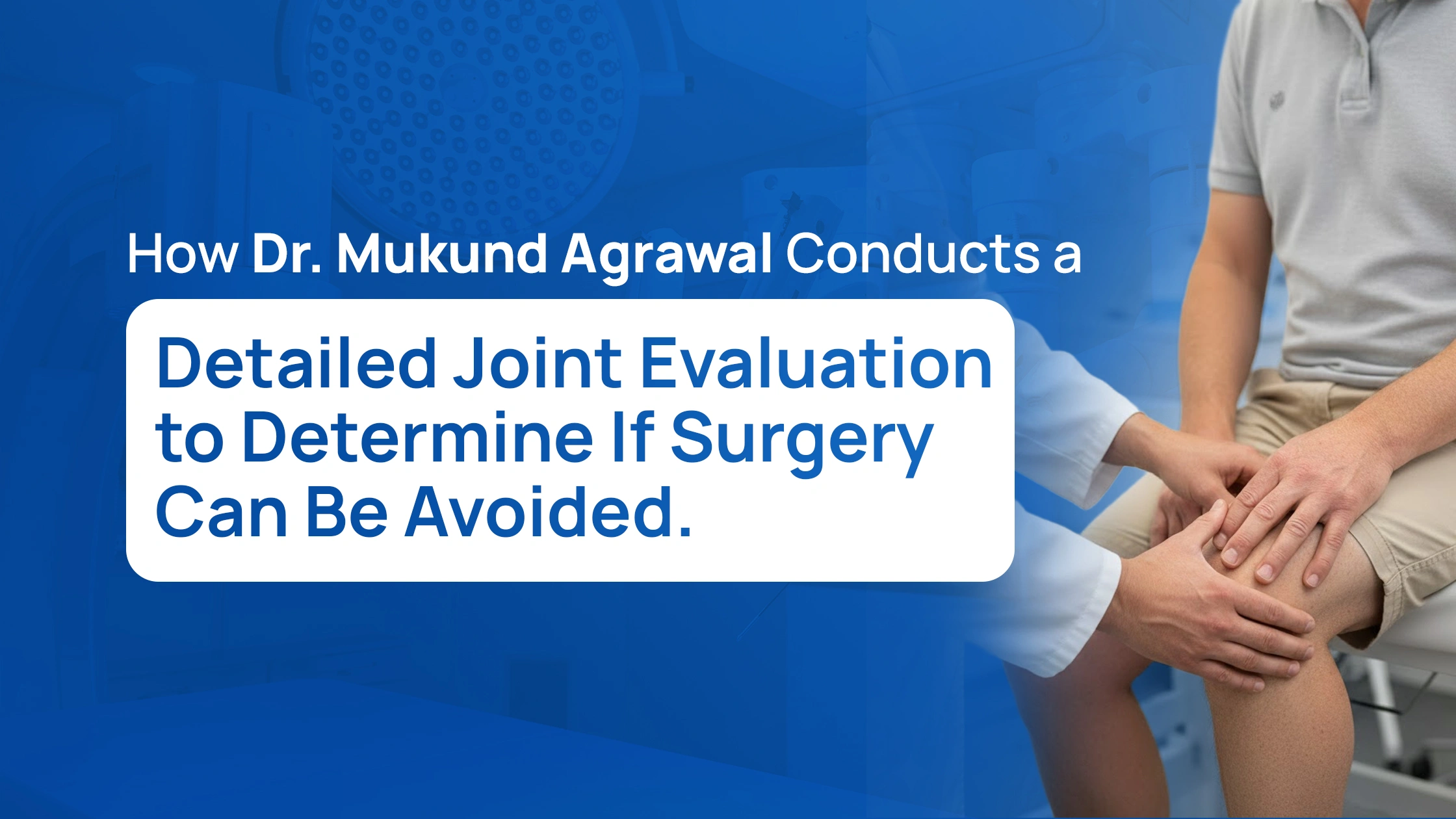
In Nagpur and across Central India, one of the most common concerns among patients with knee or hip pain is this:
“Do I really need joint replacement surgery?”
Many patients walk into a clinic after being advised knee replacement elsewhere. They are confused, anxious, and unsure whether surgery is truly the only solution. This is where a structured and detailed joint evaluation becomes crucial.
According to Dr. Mukund Agrawal, internationally trained robotic orthopaedic surgeon in Nagpur, the decision for joint replacement should never be rushed. A significant number of patients can delay—or in some cases avoid—surgery when properly evaluated.
This blog explains how Dr. Mukund Agrawal conducts a detailed joint evaluation to determine whether surgery is genuinely required or whether non-surgical solutions can be pursued safely.
Why Detailed Joint Evaluation Matters
In Central India, many patients:
- Seek multiple medical opinions
- Rely heavily on X-ray reports
- Feel pressured to take quick surgical decisions
- Delay consultation due to fear
Dr. Mukund Agrawal emphasises that knee replacement surgery is highly successful—but only when done at the right stage. Operating too early can be unnecessary. Operating too late can complicate outcomes.
The key lies in proper staging.
Step 1: Understanding the Patient, Not Just the X-ray
At his clinic in Nagpur, Dr. Mukund Agrawal begins with a detailed history:
- Duration of knee or hip pain
- Pattern of pain (activity-related vs rest pain)
- Night pain presence
- Walking distance capacity
- Climbing stairs difficulty
- Previous treatments tried
- Impact on quality of life
He strongly believes that imaging should support the diagnosis—not dictate it.
Many patients with severe-looking X-rays function reasonably well. Others with moderate imaging findings experience severe pain due to muscle imbalance or inflammation.
Step 2: Functional & Biomechanical Assessment
A detailed physical examination follows, including:
- Alignment analysis (bow legs / knock knees)
- Joint stability testing
- Muscle strength assessment
- Range of motion evaluation
- Gait analysis
Dr. Mukund Agrawal explains that weak quadriceps muscles and poor biomechanics often worsen symptoms even in moderate arthritis cases.
In such situations, surgery may not be immediately required.
Step 3: Correlating Clinical Findings with Imaging
In Nagpur, many patients directly seek MRI or X-rays before consultation.
Dr. Mukund Agrawal carefully correlates:
- Clinical symptoms
- Physical findings
- Radiological grading
He evaluates:
- Cartilage wear stage
- Joint space narrowing
- Deformity progression
- Ligament integrity
Only when all three parameters align toward end-stage arthritis does he consider recommending knee replacement.
Patients Who Often Avoid Immediate Surgery
Based on clinical experience in Central India, Dr. Mukund Agrawal observes that surgery can often be delayed in patients who:
- Have early to mid-stage osteoarthritis
- Experience pain mainly during activity
- Do not have severe deformity
- Maintain reasonable walking ability
- Are motivated to follow structured treatment
For these patients, non-surgical interventions can provide meaningful relief.
Structured Non-Surgical Pathway in Nagpur
When surgery is not immediately required, Dr. Mukund Agrawal may recommend:
Targeted Physiotherapy
Strengthening key muscle groups to reduce joint load.
Weight Management
Even small weight reduction reduces knee pressure significantly.
Guided Joint Injections
Including PRP and orthobiologic treatments where appropriate.
Activity Modification
Balancing joint protection with continued mobility.
This staged approach allows many patients in Nagpur to improve function and delay surgery safely.
When Surgery Becomes the Right Choice
Dr. Mukund Agrawal is equally clear that avoidance should not become denial.
Joint replacement becomes appropriate when:
- Persistent night pain occurs
- Walking distance becomes severely limited
- Daily activities are compromised
- Deformity progresses
- Non-surgical care fails consistently
In such cases, delaying surgery may reduce outcomes.
This balanced approach builds trust among patients across Central India.
Why Patients in Nagpur Trust Dr. Mukund Agrawal’s Evaluation
Patients from Nagpur, Vidarbha, Madhya Pradesh, and nearby regions choose Dr. Mukund Agrawal because:
- He explains every stage clearly
- He does not recommend surgery prematurely
- He offers non-surgical options when appropriate
- He combines international training with local accessibility
- He prioritises long-term joint health
At his Sadar-based practice, the focus is not on “operating more” but on operating wisely.
The Central Message
For patients in Nagpur searching online for:
- “Can knee replacement be avoided?”
- “Best orthopaedic doctor in Nagpur for second opinion”
- “Non-surgical knee treatment in Nagpur”
The answer lies in detailed evaluation—not assumptions.
As Dr. Mukund Agrawal often states:
“The goal is not to avoid surgery at any cost. The goal is to choose the right treatment at the right time.”
Final Takeaway
A proper joint evaluation can:
- Prevent unnecessary surgery
- Delay joint replacement safely
- Improve mobility with non-surgical care
- Help patients take informed decisions
For residents of Nagpur and Central India, consulting Dr. Mukund Agrawal for a structured joint evaluation provides clarity before committing to a life-changing procedure like knee replacement.
