
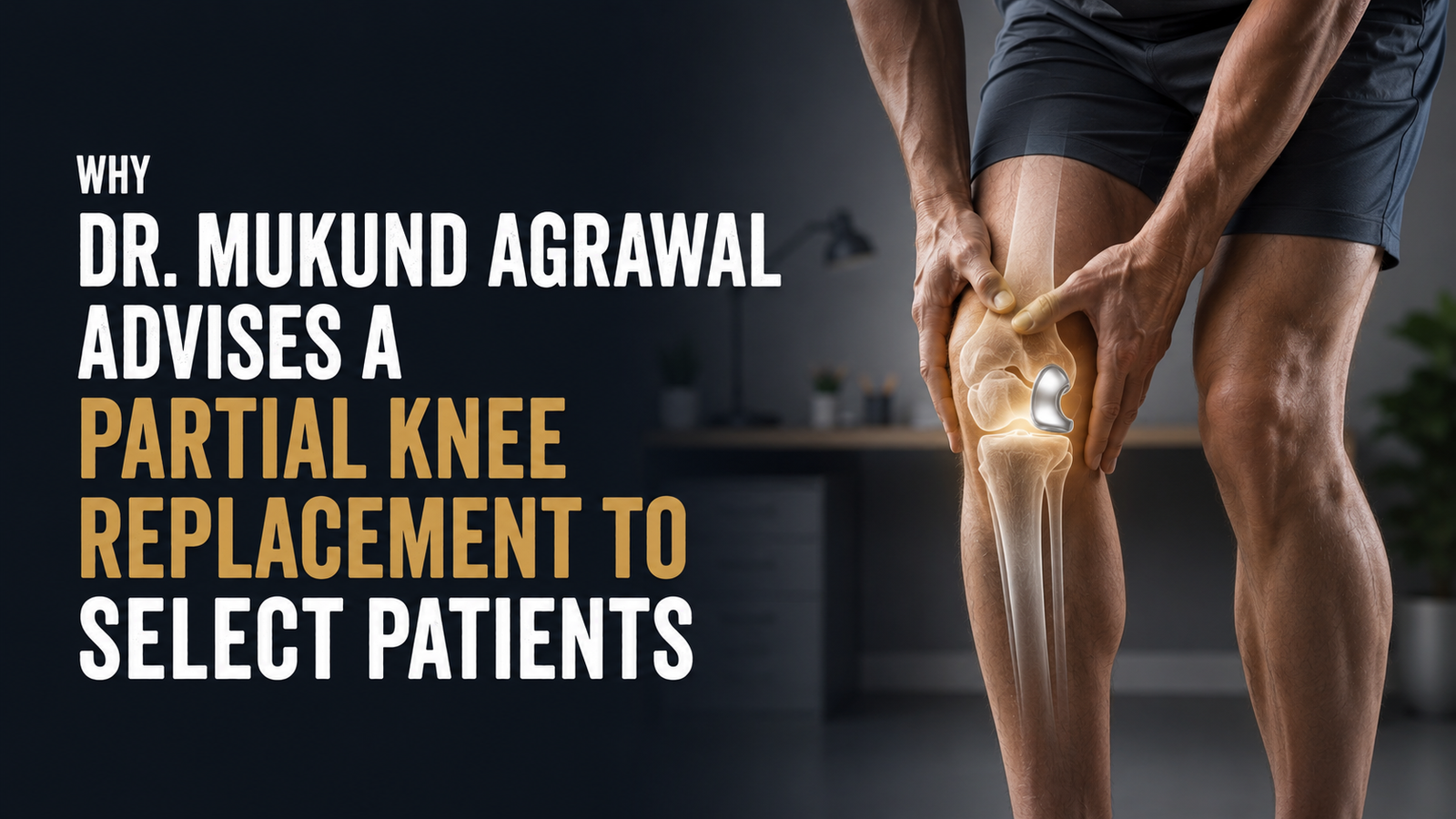
Why Dr. Mukund Agrawal Advises a Partial Knee Replacement to Select Patients
Not every patient with joint pain needs surgery. In fact, one of the biggest shifts in modern orthopaedics is the growing focus on preserving joints rather than replacing them whenever possible. This is where Ortho-Biologics has emerged as one of the most exciting developments in musculoskeletal medicine.
Dr. Mukund Agrawal strongly believes that early intervention, regenerative therapies, and joint preservation can help many patients delay- or even avoid-major surgery when appropriate. Ortho-biologics is an important part of that philosophy. But what exactly are ortho-biologics, and why are they receiving so much attention in orthopaedic care?
What Are Ortho-Biologics?
Ortho-biologics are biological substances used to support the body’s natural healing processes.
These treatments are derived from naturally occurring materials within the body or from biological sources that contain healing factors capable of promoting tissue repair, reducing inflammation, and supporting regeneration.
Unlike conventional treatments that primarily focus on symptom control, ortho-biologics aim to enhance the body’s own ability to heal damaged tissues.
The goal is not simply to reduce pain—it is to improve tissue health and function.
Why Has Interest in Ortho-Biologics Increased?
Traditional treatments for joint pain and sports injuries often include:
- Pain medications
- Anti-inflammatory drugs
- Physiotherapy
- Activity modification
- Steroid injections
- Surgery
While these treatments continue to play an important role, patients and surgeons alike are increasingly looking for solutions that address the underlying tissue damage rather than only controlling symptoms.
Advances in regenerative medicine have made it possible to support healing in ways that were not available a few decades ago.
This is where ortho-biologics can be particularly valuable.
How Do Ortho-Biologics Work?
The body naturally possesses remarkable healing mechanisms.
When tissues are injured, biological signals trigger:
- Cellular repair processes
- Blood vessel formation
- Tissue regeneration
- Inflammation control
- Collagen production
Ortho-biologics work by concentrating or enhancing these natural healing mechanisms and delivering them to areas that need support.
The treatment aims to create an environment that encourages tissue recovery and regeneration.
Common Types of Ortho-Biologics
Modern orthopaedics utilizes several forms of biologic therapies.
Platelet-Rich Plasma (PRP)
PRP is one of the most widely used orthobiologic treatments.
It involves concentrating platelets from the patient’s own blood and injecting them into the affected area.
Platelets contain growth factors that may support tissue healing and reduce inflammation. PRP is commonly used for:
- Early arthritis
- Tendon injuries
- Ligament injuries
- Sports injuries
- Chronic musculoskeletal pain
Bone Marrow-Derived Biologics
Certain regenerative treatments utilize cells and biological factors obtained from bone marrow. These therapies are being studied for their potential role in tissue repair and joint preservation.
Other Regenerative Therapies
As regenerative medicine continues to evolve, newer biologic approaches are being explored to support cartilage, tendon, ligament, and bone healing. Research in this field is expanding rapidly and continues to shape the future of orthopaedic care.
Which Conditions May Benefit from Ortho-Biologics?
While every patient requires individualized evaluation, ortho-biologics may be considered in a variety of conditions.
Early Knee Arthritis
Patients with mild to moderate arthritis often seek alternatives before considering surgery. Biologic treatments may help reduce symptoms and improve joint function in carefully selected cases.
Sports Injuries
Athletes frequently experience tendon, ligament, and muscle injuries that can benefit from regenerative treatment strategies.
Tendon Disorders
Conditions such as tennis elbow, golfer’s elbow, Achilles tendinopathy, and rotator cuff tendinopathy may be treated using biologic therapies as part of a comprehensive treatment plan.
Ligament Injuries
Certain ligament injuries may benefit from enhanced biological healing support.
Cartilage Damage
Early cartilage degeneration and focal cartilage injuries are areas where regenerative orthopaedics continues to show promising developments.
The Joint Preservation Philosophy
One reason Dr. Mukund Agrawal emphasizes ortho-biologics is because of his commitment to joint preservation. Joint replacement surgery remains one of the most successful procedures in modern medicine. However, not every patient is ready for surgery. Not every patient requires surgery. And not every joint problem should immediately lead to surgery. The goal is to identify patients who may benefit from regenerative treatments while preserving natural joint structures for as long as possible.
This approach is particularly valuable in younger and more active individuals.
Are Ortho-Biologics a Replacement for Surgery?
This is an important question. The answer is no. Ortho-biologics are not a substitute for every surgical condition. For advanced arthritis with severe joint destruction, significant deformity, or end-stage disease, joint replacement surgery may still be the most effective treatment.
However, biologic therapies can play an important role in earlier stages of disease and in patients seeking non-surgical treatment options.
The key is proper patient selection and realistic expectations.
The Importance of Personalized Treatment
One of the most common misconceptions is that a single treatment works for everyone.In reality, successful orthopaedic care requires individualized decision-making. Factors such as:
- Age
- Activity level
- Severity of tissue damage
- Imaging findings
- Overall health
- Functional goals
must all be considered before recommending a biologic treatment.
This is why a detailed orthopaedic evaluation remains essential.
The Future of Orthopaedics Is Regenerative
Regenerative medicine is rapidly changing how orthopaedic conditions are managed. Instead of focusing solely on symptom relief, modern treatment strategies increasingly aim to support tissue healing, preserve joint function, and improve long-term outcomes. Ortho-biologics represents an important step in that evolution. At The Joint Replacement Centre, Dr. Mukund Agrawal combines advanced orthopaedic expertise with evidence-based regenerative therapies to provide patients with comprehensive treatment options. Whether the goal is pain relief, joint preservation, or delaying surgery, ortho-biologics offers a promising pathway toward restoring movement and improving quality of life.
Because the future of orthopaedics is not only about replacing joints—it is also about helping them heal.
